Monday, November 24, 2014

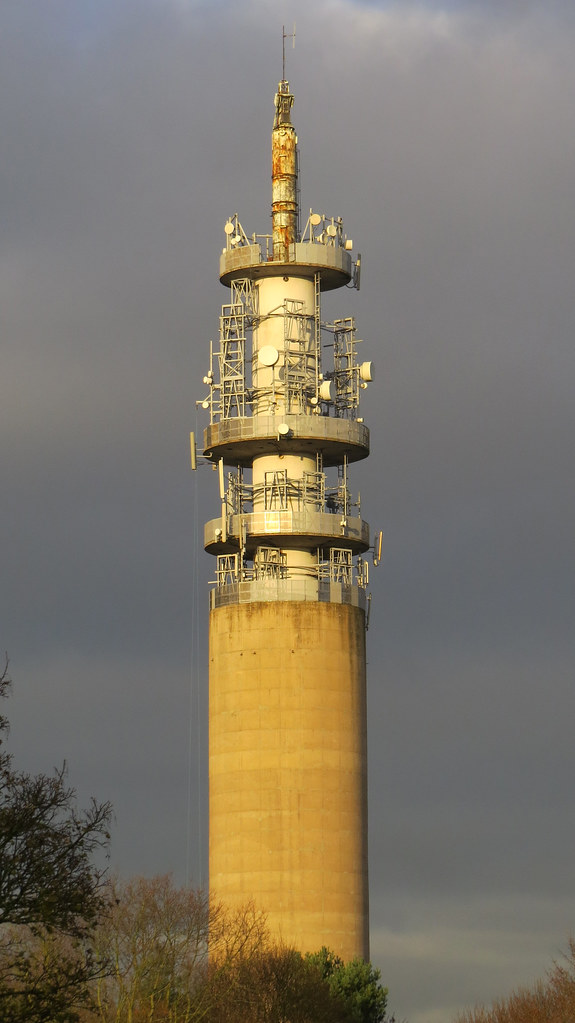
Heaton Park BT Tower

I've always had a bit of a fascination for radio towers, masts and transmitter sites and some have an interesting history. Some of my favourite types are the old British Telecom Chilterns type towers that were built around the 1960's. They are telecommunication towers built of reinforced concrete with around four platforms at the top that are used to attach point to point microwave transmission drums and a whole array of other antennas.


Heaton Park BT Tower is a Chilterns type concrete tower close to the banks of Heaton Park Reservoir, at Heaton Park, Manchester. Heaton Park tower is one of the few British towers built of reinforced concrete, and one of seven BT towers of this particular design which are all significant local landmarks and cultural icons. Heaton Park is notable because it provided a large portion of the trunk comms capacity into Manchester.

There is little information on the internet about this particular tower but it is likely to have been constructed as part of the British Cold War "Backbone" radio communications network designed to provide the UK and NATO with survivable communications in the event of nuclear war. It would have relayed signals from Sutton Common tower in Macclesfield to the south and Tinshill tower in Leeds to the north.
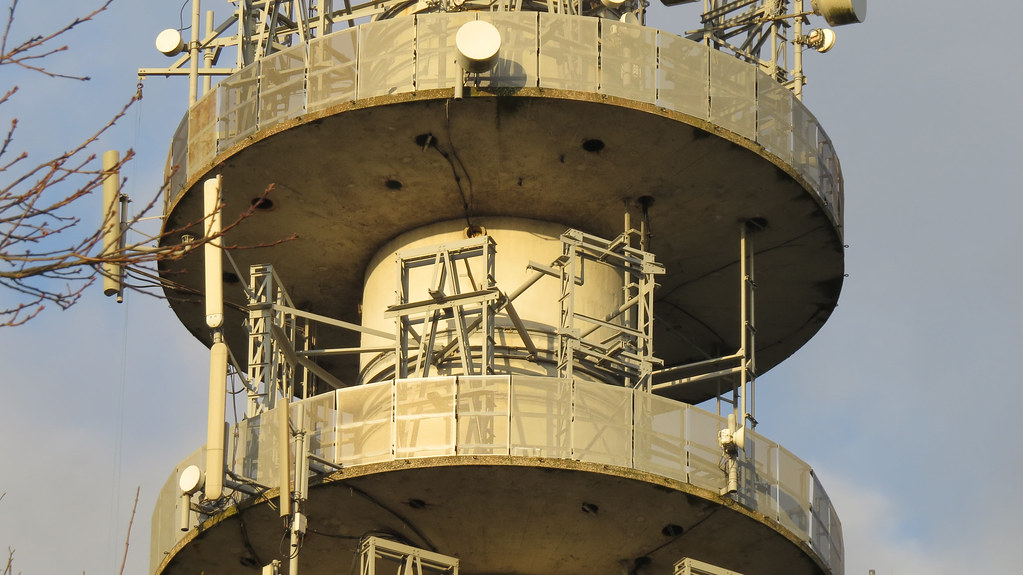


BT owns at least 200 radio masts and towers in Britain. Of these, twelve are reinforced concrete towers. The rest are of steel lattice construction. Seven of the twelve are all Chiltern type towers named after the first one which was built at Stokenchurch on the Chiltern Hills. They are identical except for their heights, which vary considerably. 

The others are located at Stokenchurch in Buckinghamshire, Charwelton in Northamptonshire, Pye Green at Cannock Chase in Staffordshire, Sutton Common near Macclesfield in Cheshire, Tinshill, in the Cookridge area of Leeds and Wotton-under-Edge in Gloucestershire.

In common with most of these sites, BT have removed the original horn antennas and replaced them with more compact dishes. The ones on the Heaton Park tower look quite new and I noticed some old dishes dumped in a pile at the base.
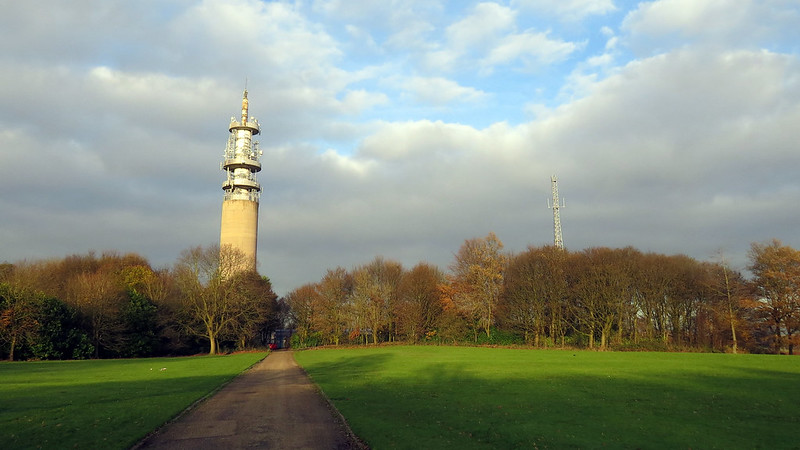
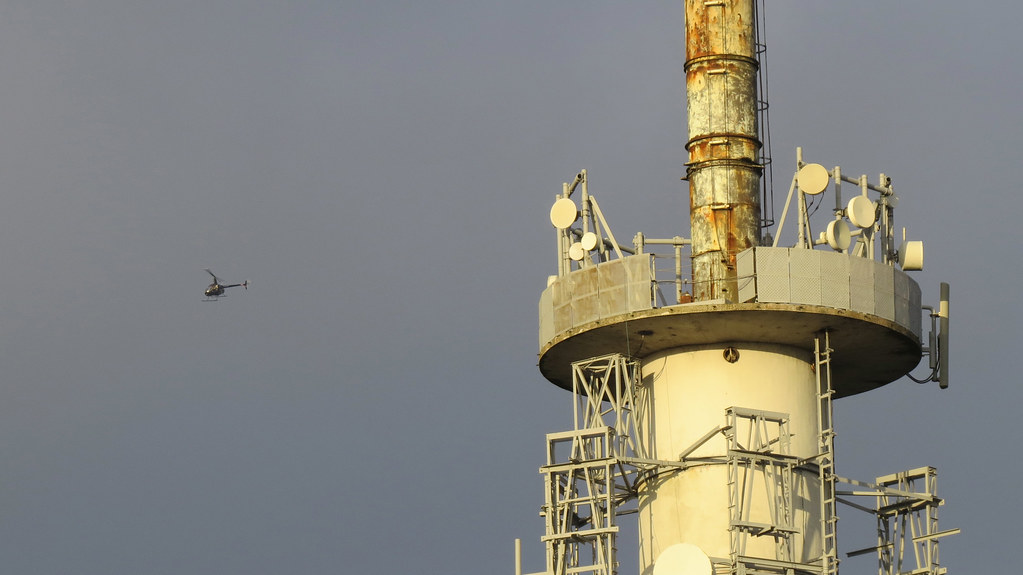


There was another antenna tower close by with 3 small and 3 larger vertical omni directional antennas on it, I have no idea what it is for but I'd guess the larger, white antennas are possibly Police Airwave antennas. Correct me if I'm wrong.


The BT tower is bare compared to how it used to look due to most of the microwave backbone network now using fiber. It still stands as a relic of a Britain where radio communication was in its heyday.

If you haven't been to Heaton Park, it is definitely worth a visit and there is plenty to do there. It made for a nice walk this afternoon for a couple of hours with plenty of wildlife around and of course this awesome BT tower.

Thanks for reading!

73's, Lewis M3HHY.
Manchester, UK.

Sunday, November 23, 2014

2.4gHz Wireless Video Scanning.

So I've been looking at a lot of videos on Youtube about wireless video scanning or 'Wi-Vi' scanning. There's not a great deal of videos on there but there's enough to get me interested. There are a couple of methods that I've started to look at and hope to get some good results from them.

The first device is a 2.4GHz wireless security/baby palm monitor LCD receiver which covers the 4 channels that all wireless cameras operate on. Pretty simple to use by the looks of things. It has a composite AV output so the receiver can be connected directly to a DVR to enable recording as well as volume, on/off switch and power adapter port.


There are 2 holes on the top and one on the front which I plan to modify to enable me to connect an external antenna to it as opposed to the internal one which I'm guessing is a wire soldered to the antenna pad on the circuit board inside. There are larger 2.4ghz WiFi aerials on eBay for a couple of pounds which should work well. One Youtuber has made a pretty cool biquad antenna attached to his which seems to deliver good results when walking down the street scanning.

It has a handy little stand on the back which I'll use to somehow attach to the dash of my car so I can scan for wireless video while driving around. There is a video of this exact unit in operation Youtube and the quality seems pretty good so as soon as the seller has them back in stock I'll snap one up and give it a try. Of course I'll post my results as and when.


This handheld device will act as a great portable wireless video scanner for all 4 channels. All for about £35 shipped. Photos courtesy of DX.com. No copyright intended.

The second device is a 2.4gHz USB 2.0 wireless dongle which plugs into a USB port and allows you to view CCTV footage. I bought one last week off eBay for about £8 shipped so not expensive however the software supplied is completely useless and just does not work. Or at leas not on Windows 7 64bit which is on my PC and laptop. I managed to scout the internet and get a driver so the computer actually recognizes the dongle, some other drivers to make it run on Windows 7 64bit and another peice of software called Yawcam to actually view the singals that the dongle draws in.


The antenna on the side unscrews from an SMA female connector on the board inside so this will allow me to attach a larger, better quality antenna. There is a video out port on the side too and the dongle comes with an audio video cable to allow connection to a TV, monitor or DVR for recording.


So all in all a bit of a disappointing start and of course it is a more fixed way of viewing wireless video unless you fancy walking or driving around with a laptop. I do plan to get a Windows tablet after Christmas so I'll connect it up with a USB cable and look to put the software on the tablet somehow and use it portable. That is unless I manage to locate the palm device first.

From what I've already seen online I'd recommend the palm device to anyone wanting to snoop in on wireless video transmissions but the dongle is a bit too much trouble and I'd probably not recommend buying one. Stay tuned for updates!
Do you have either of these? Or have you tried your hand at wireless video scanning? Drop me a comment in the box further down the page and let me know!

Thanks for reading!

73's, Lewis M3HHY.
Manchester, UK.

Wouxun KG-699E 66-88mhz Transceiver.

So I was browsing eBay as you do and I came across a 66-88mhz handheld transceiver by Wouxun. The KG-699E is something I haven't heard of so far and it looks quite good and would be great for local 4m 70mhz use without the hefty price tag of the likes of the Icom 7100 and the Yaesu FT-847. It has 200 channels and 12.5khz and 25khz steps as well as CTCSS/DCS, 1w and 5w power settings and all the usual features that come with the chinese handhelds.


They are available on eBay for as little as £65 and go up to around £80 depending on the band. The 4m version is more expensive than the regular VHF and UHF models. I found one for £70 with a COM port programming cable which is always handy and allows the user to name the channel programmed into the radio. The package looks like it contains the usual wrist strap, belt clip, drop in charger and ear piece etc but with the naturally longer helical antenna suitable for that band although I'd be tempted to use an external antenna for obvious reasons.

One problem that crops up in reviews is that scanning of memory channels in groups is not supported, so the scan button scans all active channels however this is not the end of the world and is to be expected from such a cheap radio.

All in all it looks like a nice little radio and definitely something I'll think about getting as I've not really seen a newly released radio that covers this band and I'm confident is it the only 4m handheld on the market at the moment. Correct me if I'm wrong. It is definitely a big leap forward from the Philips and Pye radios I've owned and reviewed on the radio finds page that are at least 1ft in length without the 2ft helical attached to it! Build quality looks very good as with all Wouxun radios and it is nice to see the absence of the flash light which in my opinion cheapens the look of the radio.

Do you own one of these radios? Let me know what you think by dropping me a comment in the box on the right. Any feedback is greatly appreciated.

Thanks for reading!

73's, Lewis M3HHY.
Manchester, UK.

Comparing Baofeng Radios.

There are lots of different models and styles of Baofeng radios on the market these days and it is a hell of a task deciding which one is right for you, which one does what and finding out what the differences are between the various radios. That is all before you throw the numerous counterfeit and unlicensed models into the mix.


Baofeng supply great radios for the price, I've had a few now and have never been disappointed. Sure, you pay for what you get but I personally think you get a whole lot more and these radios are crammed with loads of useful features. Choosing a radio from Bafoeng is complicated as I say but I've put a chart below which I've  borrowed from the Baofeng website (no copyright intended) to help you try and decide. 


 http://imageprocessor.websimages.com/width/935/crop/0,0,935x529/farm6.staticflickr.com/5612/15579925646_ab98556bd4_o.jpg
Click to enlarge

Certain models are not included as they are either reproductions or clones by other manufacturers under license such as the UV-82L or UV-89. Hope it helps you when choosing your new Baofeng radio.

Note, some other radios are not mentioned because vendors have paid to reproduce them but not include any extra features except misleading labels and badges as a marketing ploy. Some examples are the UV-89 and UV-82L which have no difference except labeling when compared to the UV-82. It is best to avoid these vendors as they are misleading and may not sell radios at the same quality as official Baofeng dealers.

Of course there is the BF-888s. I have a pair of these and they're about £12 new on eBay and I can't fault them either! They are 16 channel programmable radios which fit the regular Baofeng programming lead, microphones, ear pieces and antennas etc. They feature 50 CTCSS / 105 CDCSS codes, VOX function, emergency alarm (useless as it is not transmitted), intelligent charging, battery save, low voltage alert and time out timer. Frequency range is 400-470MHz, power 1 watt on low, 5 watts on high and a 3.7v 1500mAh battery.

These radios are pretty fool proof, easily programmable and quite rugged for a small, cheap handheld. They are ideal to throw in your pocket in a rush and perform well on the air. I've used these on my local repeater with good reports but like with any radio, you get what you pay for.

Lastly there is the Baofeng UV-3R and UV-3R+ model which is a slightly revamped version of the UV-3R. Some people have commented that the RX and TX quality is better than the UV-5R but the lack of a keypad makes it harder to programme. I have a UV-3R first but sold it to buy a UV-5R solely due to the keypad however I'd highly recommend the 3R too!

So Which Is The Best?

It seems even Baofeng can't decide! They have chosen the 3 radios listed below but it depends on what you're looking for. I bought a GT-3 and it has noticeably better RX and TX quality than my UV-5R. I think everybody has their own views and opinions on which radio they prefer.
  • According to Baofeng, the best overall is the UV-82 series because it features the highest quality PCB board, heavy duty casing, most ergonomic case and keypad, a louder 1 watt speaker, and overall better RX and TX than other models. The series includes the only current 220mhz Baofeng; the UV-82X and the only commercial use approved Baofeng UV-82C.
  • The best radio in UV-5R family (third generation) is the BF-F8HP because it is the only tri power radio with 1, 5 and 8 watts of power. It also features the high gain V-85 antenna, the second generation PCB board from the UV-5R, it is compatible with all UV-5R accessories, and expanded frequency range.
  • The most economical radio according to Baofeng is the BF-F8+ because it is the cheapest variant from the chart above (does not include the BF-888S or the UV-3R. It also features the second generation PCB board from the UV-5R andis compatible with all UV-5R accessories.
Hope this all helps when choosing what to buy.

Thanks for reading!

73's, Lewis M3HHY.

Manchester, UK.

Switching to the Baofeng GT-3.

So I decided to make the switch from the Baofeng UV-5R to the Baofeng GT-3 as my main dual band transceiver. I got an old marine handheld transceiver on eBay for about £6 as spares and repairs. Low and behold it just needed AA batteries and it works a treat. So I've just sold it for £40, which is the price of a Baofeng GT-3 with secondary antenna, speaker mic and car charger so I used the money to purchase one.


It should be here this week so I'll put up a review. Sorry for the lack of updates, I've been back at work after a couple of weeks holiday. I'll do my best to get a review up of the GT-3, a showing of the marine handheld and some other Motorola bits and peices.

Stay tuned!

As always, thanks for reading!

73's, Lewis M3HHY.
Manchester, UK.

RSGB 144mhz UKAC | Tuesday 7th October 2014.


I met with a friend of mine Roydan (M0LEX) to watch him take part in the RSGB 144mhz UKAC. This is a 2m USB DX contest in which radio amateurs up and down the United Kingdom and beyond attmept to work as much of the country as possible in two and a half hours.

These contests are timed to co-incide with the last two hours of a number of European activity contests, with an extra half hour at the end to encourage intra UK activity. They take place on Tuesdays from 2000-2230 local time with 144 MHz on the 1st Tuesday of the month. The country is divided up into IO squares with area codes in each square. We were in IO83.


I've never taken part in anything like this before hence coming along with Roydan to see what it was all about. We drove to a hill between Bury and Rochdale in Greater Manchester that overlooks most of Manchester and beyond. Winter Hill Arquiva transmitter site was clearly visible to the west and Croker Hill BT tower outside Macclesfield was visible to the south east. Beetham Tower in Manchester city centre sat directly to the south of our position. The weather was damp and freezing cold now Autumn is here but at least the rain that had hung around all day had now completely disappeared which made setting up Roydan's mast and antenna much easier.

When the antenna was set up on a drive on mast, we turned on and tuned in to the 2m band and had a listen round. It didn't take long for the band to come alive with operators up and down the country. It was nice to see so much activity on there and we both agreed that it restored our faith that the hobby is very much alive.


Throughout the two and a half hours Roydan managed to work exactly 100 stations. Lift conditions weren't great tonight and we struggled to make the grid squares in the far south east coast of England and the north of Scotland but we managed one Irish station. I heard a few familiar call signs from the Manchester area and many more from all over the UK but nothing from Europe tonight. I think Roydan managed 13 squares tonight.


I managed to take a few pictures of the view from the top of the hill. The panoramic photo above shows one third of the view and you can see Winter Hill mast on the right. Taken with a 15 second exposure on my tripod. All in all a great night with plenty of activity. I look forward to the next time and also giving it a go myself! Thanks Roydan!


Thanks for reading!

73's, Lewis M3HHY.
Manchester, UK.

Nagoya NA-771, Diamond SRH-771 | Identifying The Fakes

I have a couple of weeks off work so I might as well update as much as possible. I thought I'd discuss the Nagoya NA-771 and Diamond SRH-771 antennas, along with the fakes that are knocking about.

Nagoya NA-771 - Legitimate Versions.


This aerial is pretty good. The real ones range from around £5-£10 depending on the seller on eBay. I'm assuming the £1.99 ones with Nagoya written on are the cheap counterfeits. I'm unsure of the quality and specs of these antennas including SWR but I've been using a Nagoya model that I paid £7 for for some time now and it has not affected my Baofeng UV-5R and receives and carries transmission slightly better than the stock rubber duck antenna. These are quite solid and have a glossy black plastic outer.

Genuine Nagoya antennas are manufacured by REUEX Industrial Co., Ltd. in Taiwan. REUEX packages their antennas in a yellow slip case (similar to that used by genuine Diamond antennas) with a rectangular holographic trademark label (or labels) affixed. Product information lettering on the slip case shows the frequency etc white on red (e.g., "144/430 dual band hand held antenna). Gain, power capability, and dimensions are in black directly on the clear side of the slip case.

Diamond RH-771 - Fake Version.


These fake antennas come branded as RH-771. Genuine Diamond antennas use SRH-771 for an SMA connector so if you're buying one for the Chinese radios then any antenna with an SMA connector that has RH-771 on is a counterfeit Diamond product. A Diamond antenna with a BNC connector is the RH-771. The higher price of these and authorised sellers is an idication of their authenticity. I bought a couple of the SMA versions to try them out and they cost me about £1.20 each. The transmit and receive on these antennas is noticeably lesser than the Nagoya version and I dread to think what the SWR is on them.

The counterfeit antenna was packaged in a flimsy orange slip case of material about 1/2 the thickness of the genuine article and had a poor quality round holographic label stuck on it. Lettering on the slip case is blue with white outline. The antenna description is on a white background with white Chinese characters and English saying "Flexiable Spring Whip" (notice the spelling). Additional particulars are white characters on the clear portion of the slip case.

Diamond RH-771 / SRH-771 - Legitimate Versions.


As I said above, the higher price (£19 upwards) and authorised sellers is an indication of the authenticity of Diamond antennas. The signal and transmission quality of the genuine antennas is noticeably better than the counterfeit versions. The real RH-771 antenna with a BNC connector is pictured to the right.

The SMA version pictured below is the genuine Diamond antenna and as you can see it is completely different from the counterfeit SMA version. It has a longer spring section and is printed in orange lettering:


Packaging:

I've mentioned packaging briefly above and in my experience most of the genuine antennas come in a yellow sleeve and the counterfeits usually come in orange however this may not be the case 100% of the time. The various forms of packaging that these antennas come in is a give away of their authenticity. Some feature crudely made labels, spelling mistakes and incorrect specifications given for the antenna inside.

Another big giveaway is the Diamond Antenna logo. If you look below you'll see on the left the genuine logo and on the right the fake one. Can you see the difference? It is quite subtle but the genuine logo has a little diamond inside the 'E' on the word antenna. The counterfeit logo has a triangle instead:


I hope this helps you when trying to identify genuine antennas. I have bought some off of eBay advertised as Nagoya but when they arrive they have been Diamond counterfeits. With so many floating around it could be the case that the seller may not even know themselves that they are selling fake antennas. I contacted the seller and got a full refund back off them.

The info above is based purely on my own experiences with these antennas. Some info and detail has been sourced from other peoples reviews on the internet. As always, it is up to you to form your own conclusion on these antennas. Let me know your feedback by dropping me a comment or contacting me on the contact page.

As always, thanks for reading!

73's, Lewis M3HHY.
Manchester, UK.