I got the Zastone ZT-V900 that I talked about in a previous post in the mail this morning and thought I'd share some first impressions.
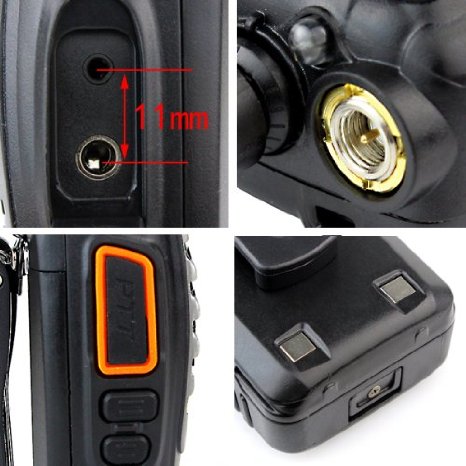
This radio is described by Zastone as bullet proof and claims to have a bullet proof plastic casing. Where they get these ideas from I have no idea, but that aside this radio is very solid, sturdy and feels very well made. It's also quite weighted too which adds to the quality feel. I bought it from a power seller for £11.60 which is a bargain compared to the £35 pricepoint on other websites. It took around 10 days to arrive which isn't to bad from China. It is single band VHF 136-174MHz and has the usual bells and whistles that any cheap radio has. One thing I like is the absence of the flashlight function! I think these cheapen any radio and was glad not to see one. The front of the radio has a nice sized screen with an alphanumeric display instead of the dot matrix display. orange backlight and a simple keypad which unfortunately doesn't light up. The left side has the PTT and monitor made from rubber unlike the plastic PTT from Baofeng. The right side of the radio has the speaker mic port which is covered by a screw on cap so it has to be removed to plug a microphone or programming cable in. In the box is the battery, radio, belt clip, hand strap, antenna, charger base and power supply. I assembled the radio together and switched it on to be greeted with the Chinese voice prompt which I quickly turned off!
The label inside the radio shows the specifications but like alot of manufacturers, they lie! The label says the radios output is 8w but it isn't. I measured it on my power meter and it is 4.7 watts.
I tested the radio and found the audio quality on RX and TX to be very good. Nice and clear and nice and loud which is perfect for the intended use. I bought this radio for using on 2m simplex in the hills. One issue I've found is programming via software. Despite managing to find the software from Zastone's website I can't seem to get it to work. I plugged the radio in with the programming cable, switched it on, opened the sofware and selected the correct port but I'm greeted by the message below every time I try to read from the radio.
I'm sure I'll find a resolution to this problem and it isn't too much of an issue as I have changed all the settings in the radio itself and there aren't any 2m repeaters in the Manchester area anymore other than GB3MI so I can manage from the VFO for now. Specifications:
All in all a
fantastic, good quality radio for the price I paid. I'm not sure I'd pay
the £35 for it as it is only single band. I'll post some test footage
in time to come.
Me and my friend Roydan M0LEX thought we'd do a bit of range testing the other day and we chose 4m analogue and 70cm DMR and analogue. I used the Wouxun KG-699E on 4m, TYT MD-380 on 70cm analogue and DMR and the Baofeng UV-82 on 70cm analogue.
Roydan used the Wouxun KG-816 pon 4m, TYT MD-380 on 70cm analogue and DMR and the Baofeng UV-5R on 70cm analogue. He also brought along his Icom E-92D.
I went to Werneth Low which is a hill in Hyde, Cheshire and Roydan went to a slightly raised area in Flixton, Manchester. The distance between us was 13.95 miles line of sight with complete visibility between us both.
For some reason the 4m test was complete waste of time. Roydan could hear me talking reasonably clear but I jsut couldn't hear him and I think it was purely down to the QRM I was receiving up on Werneth Low. Being so high above Manchester and its urban surrounds, I think his signal was just jammed by strong QRM splattered all over 4m. We're going to test it again a bit closer next time but I'm not holding out much hope. On the other hand the TYT MD-380 did fantastic on both digital and analogue on 70cm simplex. Audio on the DMR side was extremely clear with no loss or warbling whatsoever. Analogue on 70cm was very clear too on the stock antenna.
Similar story on the Baofengs with me on the UV-82 and Roydan on the UV-5R. No issues at all at 14 miles across the city. Nice clear audio at both ends and strong signals coming across. Video here:
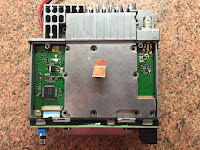
Some pictures of the inside of the Kirisun PT617A i'm hoping to get working. Mic and cable still on the way!
The massive heatsink on the back extends into the radio and covers most of the top of the board. Looks like it will take some juice when transmitting for a sink that size.
The circuit board inside is pretty simple, nothing like the older radios. Microcontroller is visible to the left and the baseband processor in the middle and I have no idea what anything else is!
RA30H1317M is a 30 watt RF MOSFET Amplifier Module commonly used on these sort of radios that operate in the 135 to175 MHz range.
On the top of the radio is the tiny speaker and some other bits and peices. The speaker just sits on a foam spacer and is not fixed in place.
Lastly is the front face, nothing really to note on there. The volume control is on the left of the photo, the mic socket is on the right. Note the picture is upside down.
Hope someone finds it interesting! Just hope I can get it running this week.
I spend a lot of time browsing online stores and other websites for new models of Chinese radios and I found one recently that made me laugh. The Veasu UV-8R! I found this on AliExpress, eBay and another leading Chinese radio store.
It is a dual band radio covering 136-176/400-520MHz on transmit and receive and contains the usual features:
Dual band, Dual display, dual standby
2w/3w/5w Power Setting
Emergency Alarm
ANI CODE(PTT ID)
FM Radio
DTMF
Low Battery Alert
Squelch Tail Elimination
Power. >5W
Channel Annunciation
Auto Power-savimg
Multiple Scanning
Sound Alarm
Keypad lockout
Full-function keypad
Program alphanumeric channel name
Large Capacity Li-ion Battery
Busy Channel Lockout(BCLO)
Squelch Level Programmable
128 memory channels
Note
the tri power setting, not sure why any manufacturer would put 2w and
3w power settings in a radio as it wouldn't be noticeable at all.
It certainly doesn't have the same price tag as a Yaesu at £300-£360. The Veasu is around £35 delivered which is a bargain for a two way radio which I have no doubt works very well.
It has all the same buttons and lights that the Yaesu has which makes me think that some factory in China has gotten hold of Yaseu injection moulds and slightly modified them to produce their own radio. Note the screen size is slightly different. Although this is a blatant copy of the Yaseu VX-8R, I do rather like it and think I'll get one in the coming weeks to test out. It is clearly a UV-5R inside as you can see from the screen layout in the image below. It claims to be submersible but that is definitely not true.
The main difference is the printing on the buttons, the keypad has different functions to the Yaesu version. Oh and the Yaesu is a tri-band radio, the Veasu is just a dual band. Technical Info:
Frequency Range
134-176/400-520MHz
Channel Capacity
128
Frequency Stability
2.5ppm
Frequency Step
2.5kHz/ 5kHz/ 6.25kHz/ 10kHz/ 12.5kHz/ 25kHz
Antenna Impedance
50Ω
Operating temperature
–20°C to +60°C
Supply voltage
Rechargeable Lithium-Ion 7.4V/1200mAh
Consumption in standby
≤75mA
Consumption in reception
380mA
Consumption in transmission
≤1.4A
Mode of operation
Simplex or semi-duplex
Transmitter
RF Power
5W/3W/2W
Type of modulation
FM
Emission class
16KφF3E/11KφF3E(W/N)
Maximum deviation
≤±5kHz/≤±2.5kHz(W/N)
Spurious emissions
<-60dB
Receiver
Receiver Sensitivity
0.2μV(at 12 dB SINAD)
Intermodulation
60dB
Audio output
1000mW
Adjacent channel selectivity
65/60dB
These Chinese clones usuall annoy the hell out of me but I do like this one, it looks the part and you'd easily mistake it for the genuine article at a glance. Stay tuned, I may well be reviewing this in time to come!
Sorry for the lack of
posts lately, work has been hectic and I've not had too much time so
I thought I'd give you guys a bit of an update.
R.A.D.A.R.S 1st Annual
Fox Hunt - August 1st 2015.
Myself and Roydan M0LEX
decided to take part in the 1st annual fox hunt that Rochdale and
District Amateur Radio Society organised. We'd never done this before
so thought it'd be a bit of fun. I've always enjoyed videos on
YouTube of the fox hunts that take place in the US and wished we had
them more over here so when I saw the notice on Transmission1 forum I
got in touch with Roydan and we put the date in our diaries!
We met at his house to
load his 2m beam into his car. It was a big old black and white TV
antenna from the 1960's that had been converted for the band. With a
bit of superglue fixing and some tweaks here and there we were good
to go. Roydan brought along his Yaesu FT857 but forgot his signal
meter (we only realised 25 minutes into our journey) so we just stuck
with the small one on the radio itself. Backup equipment was my TYT
TH-9800 and of course the obligatory Baofeng UV-82.
We then drove up to Owd
Betts public house on the edge of Ashworth Reservoir in the hills
above Rochdale. We weren't expecting many to turn up but around 6 or
7 cars took part which was a great turn out. Some dropped out due to
other commitments but the ones that were there gave us a warm welcome
before starting the brief. One of the members had a very impressive homebrew welding rod antenna:
The brief was as
follows:
The fox will transmit a
145.3875 MHz FM (Club calling frequency) signal from a fixed
location, not requiring permission for access or payment of a fee,
within a 5 mile radius of the start point. The fox may only use one
vertically polarised antenna. The fox will transmit the location at
the end of the exercise.
The hunt ends after 90
minutes, or when all hounds have found the fox (or conceded),
whichever is the earlier. Hounds without a transmission capability
should make their participation known in advance.
The start will be from
the car park opposite Owd Betts Public House, Edenfield Road,
Rochdale, OL12 7TY. Hounds should be at the start point in good time.
Each team will be given written instructions regarding the
transmission schedule and emergency contact details for the fox or a
suitable representative.
The following details
show the times, strength and duration of transmissions:
Time
Strength
Duration
1st transmission
18:00:00
High power 10 watts max
2 minutes
2nd transmission
18:15:00
High power 10 watts max
1 minute
3rd transmission
18:25:00
High power 10 watts max
1 minute
4th transmission
18:35:00
High power 10 watts max
1 minute
5th transmission
18:45:00
Low power 5 watts or less
1 minute
6th transmission
18:50:00
Low power 5 watts or less
1 minute
7th transmission
18:55:00
Low power 5 watts or less
1 minute
8th transmission
19:00:00
Low power 5 watts or less
1 minute
9th transmission
19:05:00
Low power 5 watts or less
1 minute
10th transmission
19:10:00
Low power 5 watts or less
1 minute
11th transmission
19:15:00
Low power 5 watts or less
1 minute
12th transmission
19:20:00
Low power 5 watts or less
1 minute
13th transmission
19:25:00
Low power 5 watts or less
1 minute
Final transmission
19:30:00
Low power 5 watts or less
1 minute
Debrief
19:35:00
High power 10 watts max
NA
After the brief myself and Roydan rushed back to our own 'base' to pick up the beam that we had hidden in a field and we got on our way. When the first transmission was made we quickly pulled over, got the beam out, unfolded the elements and plugged it into the radio. Roydan looked for the strongest signal and I rotated the beam. This proved to be hard work as the contest continued and meant that we missed part of a couple of transmissions and skipped a couple all together. We got our first heading and drew a line on a map from our location in the direction of the signal.
We then drove in the direction of that line and parked up ready for the next transmission to be made. At this point we did exactly the same as above and proceded in that direction. By the time the 5th or 6th transmission came along we had a rough triangle drawn on the map in which to search.
With each transmission we got closer and closer to the fox and drove past the same areas numerous times. We also passed a number of the other hunters on the way. By the 10th or 11th transmission we were about to give up when we heard the fox on the TYT 9800 with the squelch open giving us an S9. This gave us some hope and by the 12th transmission we were receiving him on the trusty Baofeng with the sqelch open and no antenna in.
By the 13th transmission we had found the fox and met up with him. It was Eddie G7DNM who is club secretary for R.A.D.A.R.S. and we had a good chat as we followed him back to Owd Betts.
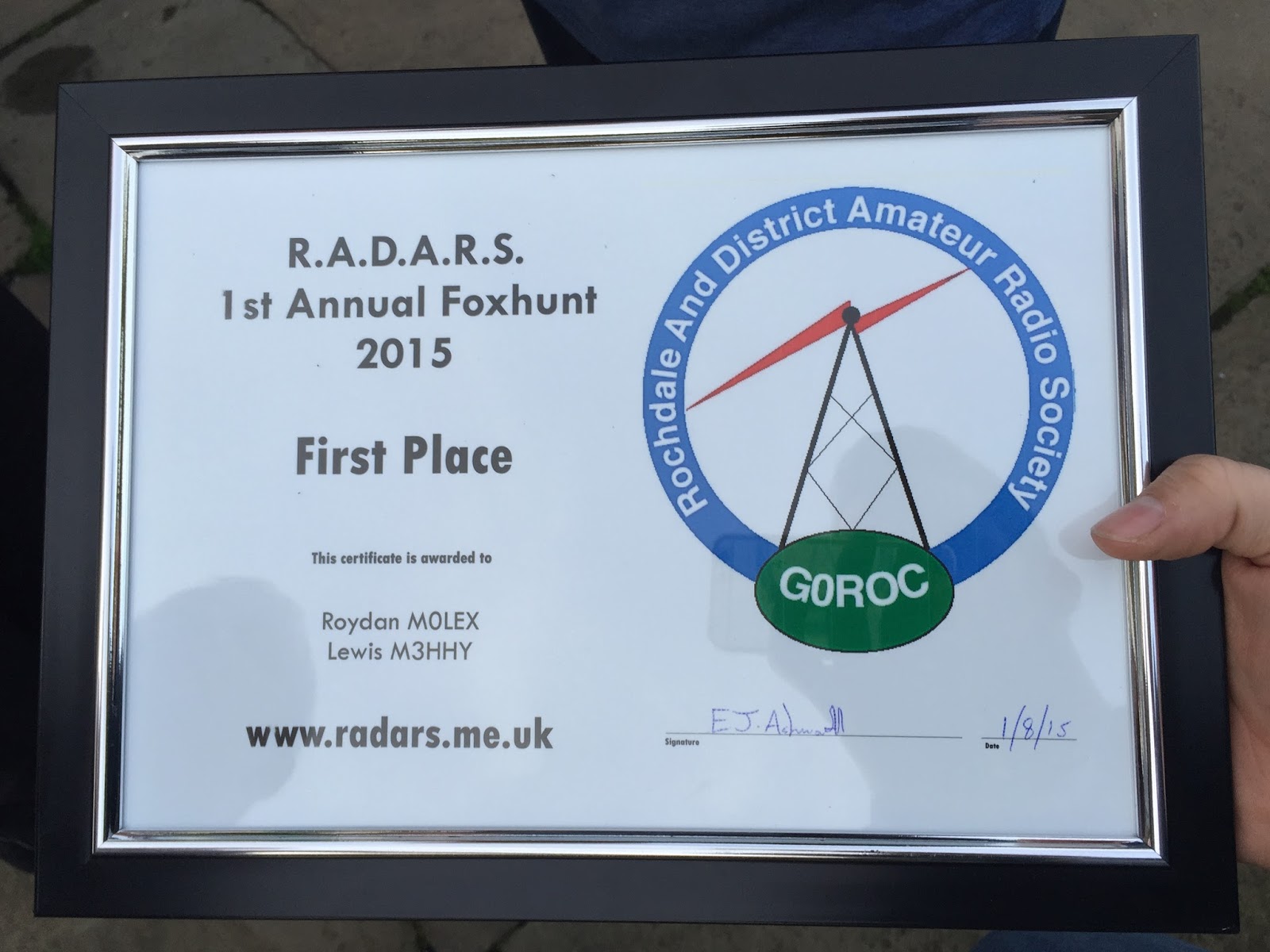
When we got back we found all the participants enjoying a well deserved pint and some food and we shared our experiences from the hunt. As myself and Roydan were last in the game and came closest to the fox, we were declared the winners and were delighted to be presented with a certificate.
All in all a very fun evening with a great turnout. Thanks to the guys at Rochdale and District Amateur Radio Society for the warm welcome and we'll see you next year!
More Radio Bargains.
Retevis R-888S
I was trawling one of the many radio related Facebook groups I've joined on facebook and found a great bargain the other week. I love these groups as they contain alot of very useful information and advice and are frequented by some very knowledgeable and helpful people. Someone posted a link to some Retevis R-888S handhelds that I just could not pass up.
The R-888S is basically the same as the Baofeng BF-888S. It is a 16 channel UHF handheld with no bells and whistles except the usual flashlight and the voice inversion which incidentally doesn't work on the Retevis model despite it saying so on the box. Anyway they were £4.99 each (£9.99 for the pair (they were only sold in pairs)) and at that price I couldn't let them go. They were listed as used but brand new which threw me a bit but it turns out they were just new old stock and therefore hadn't been used or opened. I suspect they had just sat in a warehouse in Hong Kong for a year. So I decided to order 4 for £19.98 and was made up when they came in about 3-4 days! They came in their original boxes, as described and worked fine. They came with the battery, radio, hand strap, charger, antenna, belt clip and manual written in perfect English and I much prefer the styling on these as opposed to the Baofeng variant.
I did the usual unboxing, screwed the belt clips on and programmed them all up in Chirp and they all work a treat. I programmed one for my local 70cm repeaters and 70cm simplex channels, one for Manchester Airport UHF comms, one for other local UHF comms and the last one for monitoring PMR. In The Mail: I have some radios in the mail that I wanted to try out. I'll post my results as and when they arrive. Zastone DP860
I sold my Kirisun S780's a couple of months back to fund my TYT MD-380 and wish I hadn't. Although dPMR isn't widely used and there are no repeaters for it, I felt I hadn't tried it out enough when I sold the S780's so I was browsing the internet and came across the Zastone DP860 very cheap. I've ordered a pair to try out and get to grips with and kind of start where I left off with the Kirisun S780.
I wanted to give dPMR another go on 70cm simplex locally as it isn't as easy to decode and SDR# doesn't cover it yet. These radios do text messaging over RF and have a 4w output power and they look very impressive for the price. They also cover analogue which is handy. Can't wait for these to arrive! Zastone ZT-2R+
This is a dual band handheld radio in terms of transmission capability but it has an impressive receive range that has had mixed reviews among the radio community. It does everything your UV-5R does on transmit but receives so much more: RX:
0.5-1.8 MHz (BC Band)
1.8-30 MHz (SW Band)
30-76 MHz (50 MHz HAM)
76 -108 MHz (FM)
108-137 MHz (Air Band)
137-174 MHz (144 MHz HAM)
174-222 MHz (VHF TV)
222-420 MHz (ACT1)
420-470 MHz (430 MHz HAM)
470-800 (729) MHz (UHF TV)
(757-774) MHz (UHF TV)
800-999 MHz (ACT2; USA Cellular Blocked) TX: 144-146 (148) MHz
430-440 (450) MHz Now, I know what you're thinking and I too doubt the quality of the receive on this radio in certain bands with the antenna it comes with and the low price tag but I think it's definitely worth a shot. I'm only interested in the air band section and there is alot of commercial traffic in my area above the frequency range of my Baofengs which I'll be able to monitor on the Zastone. It is about the same size as a Baofeng UV-3 so its small but it has had some excellent reviews so I think I'll be happy enough with it. I got a fantastic deal on the price of this radio so either way I won't be too disappointed it. I'll post my results when I give this radio a proper test on RX. Zastone ZT-V900
This radio looks like a distant relative of the Baofeng UV-82 and does everything a UV-5R does but I like the commercial radio look that it has and I paid around £15 for it so at that price it's definitely worth a try. It is VHF only and thought I'd give it a go on 2m when I'm out portable up my local hill. It comes with the usual stuff you get in any box that contains a cheap Chinese radio and I doubt the manual will tell me much but if it's anything like its Baofeng cousins it shouldn't be too hard to figure out. Kirisun PT617A VHF Radio
I was given this radio recently by a friend of mine who had no use for it. It came with no microphone or programming gear for it but he told me he had his Kenwood microphone working in it and it all seemed to work ok. I got it home and plugged it into my PSU in the shack and it seems to power up ok. I haven't got a compatible mic as the pin outs on my TYT and Icom mics are different. The main issue is that manual programming has been disabled in the radio when it was programmed by computer. So I've ordered a cheap Kenwood compatible mic and a Kenwood compatible programming cable to see if I can get it working. I managed to find the programming software online so fingers crossed. The worst case is I have a radio that cost me £9 to get going. The best case is that I have a VHF radio that I can use for a portable 2m comms bag that I plan on putting together. Thanks for reading!
I listened in on the DMR MARC World Wide Check In net through GB7MR the other day and was pleased with the amount of callsigns that checked in from across the world. I recorded it on video and logged most of the call signs. Video is 5 parts in a play list.
Here are the calls that I logged during the check in. I think I'll check in myself next time.